Art and Books Together Mary Cassatt Pictures of Herself
| Mary Cassatt | |
|---|---|
 Cassatt seated in a chair with an umbrella, 1913. Verso reads "The only photo for which she ever posed." | |
| Born | Mary Stevenson Cassatt (1844-05-22)May 22, 1844 Allegheny City, Pennsylvania, U.S. |
| Died | June 14, 1926(1926-06-14) (anile 82) Château de Beaufresne, virtually Paris, France |
| Nationality | American |
| Didactics | Pennsylvania Academy of the Fine Arts, Jean-Léon Gérôme, Charles Chaplin, Thomas Couture |
| Known for | Painting |
| Move | Impressionism |
| Signature | |
 | |
Mary Stevenson Cassatt (; May 22, 1844 – June fourteen, 1926)[1] was an American painter and printmaker. She was born in Allegheny Urban center, Pennsylvania (now function of Pittsburgh's Due north Side), but lived much of her adult life in France where she befriended Edgar Degas and exhibited with the Impressionists. Cassatt often created images of the social and individual lives of women, with particular emphasis on the intimate bonds between mothers and children.
She was described by Gustave Geffroy as one of "les trois grandes dames" (the iii great ladies) of Impressionism alongside Marie Bracquemond and Berthe Morisot.[2] In 1879, Diego Martelli compared her to Degas, equally they both sought to depict motility, low-cal, and design in the nigh modern sense.[3]
Early life [edit]

Cassatt was born in Allegheny City, Pennsylvania, which is now role of Pittsburgh.[4] She was born into an upper-middle-class family unit:[5] Her father, Robert Simpson Cassat (subsequently Cassatt), was a successful stockbroker and land speculator. The ancestral name had been Cossart, with the family descended from French Huguenot Jacques Cossart, who came to New Amsterdam in 1662.[vi] [seven] Her mother, Katherine Kelso Johnston, came from a cyberbanking family. Katherine Cassatt, educated and well-read, had a profound influence on her daughter.[eight] To that result, Cassatt's lifelong friend Louisine Havemeyer wrote in her memoirs: "Anyone who had the privilege of knowing Mary Cassatt'southward mother would know at once that it was from her and her lone that [Mary] inherited her power."[ix] A distant cousin of creative person Robert Henri,[10] Cassatt was one of seven children, of whom 2 died in infancy. One brother, Alexander Johnston Cassatt, later became president of the Pennsylvania Railroad. The family moved eastward, first to Lancaster, Pennsylvania, then to the Philadelphia surface area, where she started her schooling at the historic period of six.[xi]
Cassatt grew upwardly in an environment that viewed travel every bit integral to education; she spent five years in Europe and visited many of the capitals, including London, Paris, and Berlin. While abroad she learned German and French and had her first lessons in drawing and music.[12] It is likely that her first exposure to French artists Jean Auguste Dominique Ingres, Eugène Delacroix, Camille Corot, and Gustave Courbet was at the Paris Earth's Fair of 1855. Also in the exhibition were Edgar Degas and Camille Pissarro, both of whom were later her colleagues and mentors.[13]
Though her family objected to her becoming a professional artist, Cassatt began studying painting at the Pennsylvania Academy of the Fine Arts in Philadelphia at the early age of 15.[xiv] Part of her parents' business organization may have been Cassatt's exposure to feminist ideas and the bohemian behavior of some of the male students. Every bit such, Cassatt and her network of friends were lifelong advocates of equal rights for the sexes.[15] Although about xx% of the students were female person, nigh viewed fine art as a socially valuable skill; few of them were determined, as Cassatt was, to brand art their career.[xvi] She continued her studies from 1861 through 1865, the elapsing of the American Civil State of war.[4] Thomas Eakins was among her swain students; afterward Eakins was forced to resign as director of the Academy.[11]
Impatient with the slow pace of instruction and the patronizing attitude of the male person students and teachers, she decided to study the erstwhile masters on her own. She subsequently said: "There was no teaching" at the Academy. Female students could non apply live models, until somewhat afterward, and the principal preparation was primarily cartoon from casts.[17]
Cassatt decided to end her studies: At that time, no caste was granted. Later on overcoming her father'southward objections, she moved to Paris in 1866, with her mother and family unit friends acting every bit chaperones.[xviii] Since women could not yet attend the École des Beaux-Arts, Cassatt applied to study privately with masters from the school[19] and was accepted to report with Jean-Léon Gérôme, a highly regarded teacher known for his hyper-realistic technique and his depiction of exotic subjects. (A few months later on Gérôme as well accepted Eakins equally a student.[19]) Cassatt augmented her artistic grooming with daily copying in the Louvre, obtaining the required allow, which was necessary to control the "copyists", usually low-paid women, who daily filled the museum to paint copies for sale. The museum also served as a social place for Frenchmen and American female person students, who, like Cassatt, were not allowed to attend cafes where the avant-garde socialized. In this style, boyfriend creative person and friend Elizabeth Jane Gardner met and married famed academic painter William-Adolphe Bouguereau.[xx]

Toward the end of 1866, she joined a painting grade taught past Charles Joshua Chaplin, a genre artist. In 1868, Cassatt also studied with creative person Thomas Couture, whose subjects were mostly romantic and urban.[21] On trips to the countryside, the students drew from life, particularly the peasants going about their daily activities. In 1868, one of her paintings, A Mandoline Thespian, was accepted for the first time by the selection jury for the Paris Salon. With Elizabeth Jane Gardner, whose work was also accepted by the jury that year, Cassatt was one of two American women to first exhibit in the Salon.[seven] A Mandoline Player is in the Romantic manner of Corot and Couture,[22] and is i of only two paintings from the first decade of her career that is documented today.[23]
The French art scene was in a process of change, as radical artists such as Courbet and Édouard Manet tried to break abroad from accepted Academic tradition and the Impressionists were in their formative years. Cassatt'south friend Eliza Haldeman wrote domicile that artists "are leaving the Academy mode and each seeking a new manner, consequently but now everything is Chaos."[20] Cassatt, on the other hand, continued to work in the traditional manner, submitting works to the Salon for over 10 years, with increasing frustration.
Returning to the United states in the belatedly summertime of 1870—equally the Franco-Prussian War was starting—Cassatt lived with her family in Altoona. Her father continued to resist her called vocation, and paid for her basic needs, just not her art supplies.[24] Cassatt placed two of her paintings in a New York gallery and found many admirers but no purchasers. She was also dismayed at the lack of paintings to study while staying at her summertime residence. Cassatt fifty-fifty considered giving up art, equally she was determined to brand an independent living. She wrote in a alphabetic character of July 1871, "I accept given up my studio & torn upward my father's portrait, & have not touched a brush for six weeks nor ever will over again until I encounter some prospect of getting back to Europe. I am very anxious to go out west side by side fall & get some employment, merely I take not yet decided where."[25]
Cassatt traveled to Chicago to try her luck, just lost some of her early paintings in the Slap-up Chicago Fire of 1871.[26] Shortly afterward, her work attracted the attention of Roman Catholic Bishop Michael Domenec of Pittsburgh, who commissioned her to paint ii copies of paintings by Correggio in Parma, Italy, advancing her enough money to cover her travel expenses and role of her stay.[27] In her excitement she wrote, "O how wild I am to get to work, my fingers farely crawling & my eyes water to see a fine picture again".[28] With Emily Sartain, a beau artist from a well-regarded artistic family unit from Philadelphia, Cassatt set out for Europe again.
Impressionism [edit]

Within months of her return to Europe in the autumn of 1871, Cassatt'due south prospects had brightened. Her painting Two Women Throwing Flowers During Carnival was well received in the Salon of 1872, and was purchased. She attracted much favorable notice in Parma and was supported and encouraged by the art community there: "All Parma is talking of Miss Cassatt and her flick, and everyone is anxious to know her".[29]

Oil, c. 1871, private collection. Mrs. Currey had worked for the Cassatt family. When Mary Cassatt returned habitation from Paris at the outbreak of the Franco-Prussian war, she asked Mrs. Currey to pose for her and gave her the sketch. Superimposed (the canvas turned upside down) is a sketch of her male parent.
Afterward completing her commission for the bishop, Cassatt traveled to Madrid and Seville, where she painted a group of paintings of Spanish subjects, including Spanish Dancer Wearing a Lace Mantilla (1873, in the National Museum of American Art, Smithsonian Institution). In 1874, she fabricated the decision to have upwards residence in France. She was joined past her sister Lydia who shared an apartment with her. Cassatt opened a studio in Paris. Louisa May Alcott's sis, Abigail May Alcott, was then an art student in Paris and visited Cassatt.[vii] Cassatt connected to express criticism of the politics of the Salon and the conventional gustation that prevailed there. She was edgeless in her comments, equally reported past Sartain, who wrote: "she is entirely too slashing, snubs all modern art, disdains the Salon pictures of Cabanel, Bonnat, all the names we are used to revere".[thirty]
Cassatt saw that works by female person artists were frequently dismissed with antipathy unless the creative person had a friend or protector on the jury, and she would non flirt with jurors to back-scratch favor.[31] Her cynicism grew when one of the two pictures she submitted in 1875 was refused by the jury, only to be accepted the post-obit twelvemonth after she darkened the background. She had quarrels with Sartain, who thought Cassatt too outspoken and self-centered, and eventually they parted. Out of her distress and self-criticism, Cassatt decided that she needed to motility abroad from genre paintings and onto more than stylish subjects, in order to attract portrait commissions from American socialites away, but that effort bore little fruit at commencement.[32]

In 1877, both her entries were rejected, and for the start fourth dimension in seven years she had no works in the Salon.[33] At this low betoken in her career she was invited by Edgar Degas to evidence her works with the Impressionists, a group that had begun their own series of independent exhibitions in 1874 with much attendant notoriety. The Impressionists (likewise known as the "Independents" or "Intransigents") had no formal manifesto and varied considerably in bailiwick affair and technique. They tended to prefer plein air painting and the application of vibrant color in separate strokes with fiddling pre-mixing, which allows the eye to merge the results in an "impressionistic" style. The Impressionists had been receiving the wrath of the critics for several years. Henry Bacon, a friend of the Cassatts, thought that the Impressionists were and then radical that they were "afflicted with some hitherto unknown disease of the centre".[34] They already had 1 female member, creative person Berthe Morisot, who became Cassatt'due south friend and colleague.
Cassatt admired Degas, whose pastels had made a powerful impression on her when she encountered them in an art dealer'due south window in 1875. "I used to become and flatten my nose against that window and absorb all I could of his art," she later recalled. "It changed my life. I saw art and then every bit I wanted to see it."[35] She accepted Degas' invitation with enthusiasm and began preparing paintings for the next Impressionist evidence, planned for 1878, which (after a postponement because of the World's Fair) took place on April 10, 1879. She felt comfortable with the Impressionists and joined their cause enthusiastically, declaring: "we are conveying on a despairing fight & need all our forces".[36] Unable to attend cafes with them without attracting unfavorable attention, she met with them privately and at exhibitions. She now hoped for commercial success selling paintings to the sophisticated Parisians who preferred the avant-garde. Her style had gained a new spontaneity during the intervening two years. Previously a studio-bound artist, she had adopted the practice of conveying a sketchbook with her while out-of-doors or at the theater, and recording the scenes she saw.[37]

In 1877, Cassatt was joined in Paris by her father and mother, who returned with her sister Lydia, all eventually to share a large flat on the fifth floor of 13, Avenue Trudaine, ( 48°52′54″N ii°20′41″Due east / 48.8816°N ii.3446°East / 48.8816; two.3446 ). Mary valued their companionship, every bit neither she nor Lydia had married. A case was made that Mary suffered from narcissistic disturbance, never completing the recognition of herself every bit a person outside of the orbit of her mother.[38] Mary had decided early in life that marriage would be incompatible with her career. Lydia, who was frequently painted by her sister, suffered from recurrent bouts of affliction, and her decease in 1882 left Cassatt temporarily unable to piece of work.[39]
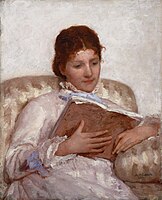
Cassatt's father insisted that her studio and supplies exist covered by her sales, which were withal meager. Agape of having to paint "potboilers" to make ends encounter, Cassatt applied herself to produce some quality paintings for the adjacent Impressionist exhibition.[11] Three of her near accomplished works from 1878 were Portrait of the Artist (self-portrait), Little Girl in a Blue Armchair, and Reading Le Figaro (portrait of her female parent).

Degas had considerable influence on Cassatt. Both were highly experimental in their use of materials, trying distemper and metallic paints in many works, such as Woman Standing Holding a Fan, 1878–79 (Amon Carter Museum of American Fine art).[40]
She became extremely proficient in the use of pastels, eventually creating many of her near important works in this medium. Degas as well introduced her to etching, of which he was a recognized master. The two worked next for a while, and her draftsmanship gained considerable forcefulness nether his tutelage. 1 instance of her thoughtful approach to the medium of drypoint as a mode for reflecting on her status every bit an artist is 'Reflection' of 1889–90, which has recently been interpreted equally a self-portrait.[41] Degas in turn depicted Cassatt in a series of etchings recording their trips to the Louvre. She treasured his friendship merely learned non to wait too much from his fickle and temperamental nature after a project they were collaborating on at the fourth dimension, a proposed journal devoted to prints, was abruptly dropped by him.[42] The sophisticated and well-dressed Degas, then forty-five, was a welcome dinner guest at the Cassatt residence, and also they at his soirées.[43]
The Impressionist exhibit of 1879 was the most successful to engagement, despite the absence of Renoir, Sisley, Manet and Cézanne, who were attempting once again to gain recognition at the Salon. Through the efforts of Gustave Caillebotte, who organized and underwrote the prove, the group made a turn a profit and sold many works, although the criticism continued as harsh every bit always. The Revue des Deux Mondes wrote, "Yard. Degas and Mlle. Cassatt are, all the same, the only artists who distinguish themselves... and who offering some attraction and some alibi in the pretentious show of window dressing and infantile daubing".[44]
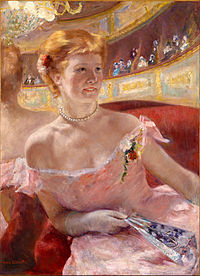
Cassatt displayed eleven works, including Lydia in a Loge, Wearing a Pearl Necklace, (Adult female in a Loge). Although critics claimed that Cassatt'south colors were likewise bright and that her portraits were too accurate to exist flattering to the subjects, her piece of work was not savaged equally was Monet's, whose circumstances were the almost desperate of all the Impressionists at that time. She used her share of the profits to buy a piece of work by Degas and one by Monet.[45] She participated in the Impressionist Exhibitions that followed in 1880 and 1881, and she remained an active member of the Impressionist circle until 1886. In 1886, Cassatt provided two paintings for the showtime Impressionist exhibition in the US, organized by art dealer Paul Durand-Ruel. Her friend Louisine Elder married Harry Havemeyer in 1883, and with Cassatt every bit advisor, the couple began collecting the Impressionists on a yard calibration. Much of their vast collection is now in the Metropolitan Museum of Art in New York City.[46]
Cassatt likewise made several portraits of family members during that catamenia, of which Portrait of Alexander Cassatt and His Son Robert Kelso (1885) is ane of her best regarded. Cassatt'southward style then evolved, and she moved away from Impressionism to a simpler, more straightforward approach. She began to exhibit her works in New York galleries as well. After 1886, Cassatt no longer identified herself with whatever art movement and experimented with a diversity of techniques.[11]
Feminist Viewpoints and the "New Woman" [edit]

Reading "Le Figaro" by Mary Cassatt (1878), Drove Mrs. Eric de Spoelberch, Haverford, Pennsylvania
Cassatt and her contemporaries enjoyed the wave of feminism that occurred in the 1840s, allowing them access to educational institutions at newly coed colleges and universities, such as Oberlin and the Academy of Michigan. Besides, women'due south colleges such equally Vassar, Smith and Wellesley opened their doors during this time. Cassat was an outspoken advocate for women's equality, campaigning with her friends for equal travel scholarships for students in the 1860s, and the right to vote in the 1910s.[15]
Mary Cassatt depicted the "New Woman" of the 19th century from the woman's perspective. As a successful, highly trained woman artist who never married, Cassatt—like Ellen Twenty-four hour period Hale, Elizabeth Bury, Elizabeth Nourse and Cecilia Beaux—personified the "New Adult female".[47] She "initiated the profound beginnings in recreating the image of the 'new' women", drawn from the influence of her intelligent and agile mother, Katherine Cassatt, who believed in educating women to be knowledgeable and socially active. She is depicted in Reading 'Le Figaro' (1878).[48]
Although Cassatt did not explicitly make political statements nearly women's rights in her piece of work, her artistic portrayal of women was consistently washed with dignity and the suggestion of a deeper, meaningful inner life.[15] Cassatt objected to being stereotyped as a "adult female artist", she supported women's suffrage, and in 1915 showed 18 works in an exhibition supporting the movement organised by Louisine Havemeyer, a committed and active feminist.[49] The exhibition brought her into conflict with her sister-in-law Eugenie Carter Cassatt, who was anti-suffrage and who boycotted the testify along with Philadelphia gild in general. Cassatt responded past selling off her work that was otherwise destined for her heirs. In item The Canoeing Party, thought to have been inspired by the birth of Eugenie's girl Ellen Mary, was bought by the National Gallery, Washington DC.[l] [51]
Human relationship with Degas [edit]

Edgar Degas, Mary Cassatt Seated, Property Cards, c. 1880–1884, oil on canvas, 74 × sixty cm, National Portrait Gallery, Washington DC. NPG.84.34 Cassatt hated information technology later and wrote to her dealer Paul Durand-Ruel in 1912 or 1913 that "I don't want anyone to know that I posed for it."
Cassatt and Degas had a long period of collaboration. The two painters had studios close together, Cassatt at nineteen, rue Laval, ( 48°52′51″N two°twenty′18″E / 48.8808°N 2.3384°E / 48.8808; 2.3384 ), Degas at iv, rue Frochot, ( 48°52′52″N 2°20′sixteen″E / 48.8811°N 2.3377°E / 48.8811; two.3377 ),[52] less than a 5-minute stroll apart, and Degas adult the habit of looking in at Cassatt'south studio and offering her advice and helping her gain models.[37]
They had much in common: they shared like tastes in art and literature, came from affluent backgrounds, had studied painting in Italy, and both were contained, never marrying. The caste of intimacy between them cannot exist assessed now, as no letters survive, but it is unlikely they were in a relationship given their conservative social backgrounds and strong moral principles. Several of Vincent van Gogh'south messages attest Degas' sexual continence.[53] Degas introduced Cassatt to pastel and engraving, both of which Cassatt quickly mastered, while for her part Cassatt was instrumental in helping Degas sell his paintings and promoting his reputation in America.[54]
Both regarded themselves every bit figure painters, and the art historian George Shackelford suggests they were influenced by the art critic Louis Edmond Duranty'south appeal in his pamphlet The New Painting for a revitalization in figure painting: "Let united states of america take get out of the stylized homo body, which is treated like a vase. What we need is the characteristic modern person in his clothes, in the midst of his social surroundings, at home or out in the street."[55] [56]

Mary Cassatt, Self-Portrait, c. 1880, gouache and watercolor over graphite on paper, 32.7cm x 24.6cm, National Portrait Gallery, Washington DC. NPG.76.33[57]

After Cassatt's parents and sis Lydia joined Cassatt in Paris in 1877, Degas, Cassatt, and Lydia were frequently to be seen at the Louvre studying artworks together. Degas produced two prints, notable for their technical innovation, depicting Cassatt at the Louvre looking at artworks while Lydia reads a guidebook. These were destined for a prints journal planned by Degas (together with Camille Pissarro and others), which never came to fruition. Cassatt frequently posed for Degas, notably for his millinery series trying on hats.
Around 1884, Degas fabricated a portrait in oils of Cassatt, Mary Cassatt Seated, Property Cards.[a] A Self-Portrait (c. 1880) by Cassatt depicts her in the identical chapeau and apparel, leading art historian Griselda Pollock to speculate they were executed in a joint painting session in the early years of their associate.[59]
Cassatt and Degas worked near closely together in the fall and winter of 1879–lxxx when Cassatt was mastering her printmaking technique. Degas endemic a small printing press, and past day she worked at his studio using his tools and press while in the evening she made studies for the carving plate the next solar day. Withal, in April 1880, Degas abruptly withdrew from the prints periodical they had been collaborating on, and without his support the project folded. Degas' withdrawal piqued Cassatt who had worked hard at preparing a print, In the Opera Box, in a big edition of fifty impressions, no uncertainty destined for the periodical. Although Cassatt's warm feelings for Degas were to concluding her entire life, she never again worked with him as closely as she had over the prints journal. Mathews notes that she ceased executing her theater scenes at this time.[sixty]
Degas was forthright in his views, as was Cassatt.[threescore] They clashed over the Dreyfus affair (early in her career she had executed a portrait of the fine art collector Moyse Dreyfus, a relative of the court-martialled lieutenant at the center of the affair).[b] [62] [63] Cassatt later expressed satisfaction at the irony of Lousine Havermeyer's 1915 joint exhibition of hers and Degas' work being held in aid of women's suffrage, as capable of affectionately repeating Degas' antifemale comments every bit being estranged by them (when viewing her Two Women Picking Fruit for the first time, he had commented "No woman has the correct to draw like that").[64] From the 1890s onwards their relationship took on a incomparably commercial attribute, as in full general had Cassatt'southward other relations with the Impressionist circumvolve;[63] [65] yet they continued to visit each other until Degas died in 1917.[66]
Later life [edit]

Cassatt's reputation is based on an extensive series of rigorously drawn and tenderly observed paintings and prints on the theme of the mother and child. The primeval dated work on this subject is the drypoint Gardner Held by His Mother (an impression inscribed "Jan/88" is in the New York Public Library),[68] although she had painted a few before works on the theme. Some of these works depict her ain relatives, friends, or clients, although in her later years she generally used professional models in compositions that are oftentimes reminiscent of Italian Renaissance depictions of the Madonna and Child. Later on 1900, she concentrated almost exclusively on mother-and-child subjects, such every bit Woman with a Sunflower.[69] Viewers may be surprised to discover that despite her focus on portraying mother-kid pairs in her portraits, "Cassatt rejected the idea of condign a wife and female parent..."[70]
The 1890s were Cassatt'southward busiest and most creative period. She had matured considerably and became more than diplomatic and less edgeless in her opinions. She too became a office model for young American artists who sought her advice. Among them was Lucy A. Bacon, whom Cassatt introduced to Camille Pissarro. Though the Impressionist group disbanded, Cassatt nonetheless had contact with some of the members, including Renoir, Monet, and Pissarro.[71]

Mary Cassatt, Mother and Child Earlier a Pool, c. 1898. Drypoint and aquatint on laid paper, Brooklyn Museum
In 1891, she exhibited a series of highly original colored drypoint and aquatint prints, including Adult female Bathing and The Coiffure, inspired past the Japanese masters shown in Paris the yr before. (See Japonism) Cassatt was attracted to the simplicity and clarity of Japanese design, and the adept use of blocks of color. In her estimation, she used primarily low-cal, delicate pastel colors and avoided black (a "forbidden" color among the Impressionists). Adelyn D. Breeskin, the author of 2 catalogue raisonnés of Cassatt'south piece of work, comments that these colored prints, "now stand every bit her about original contribution... adding a new chapter to the history of graphic arts...technically, as colour prints, they accept never been surpassed".[72]


Also in 1891, Chicago businesswoman Bertha Palmer approached Cassatt to pigment a 12' × 58' mural about "Modern Woman" for the Women's Building for the World's Columbian Exposition to exist held in 1893. Cassatt completed the project over the next two years while living in France with her mother. The mural was designed as a triptych. The key theme was titled Young Women Plucking the Fruits of Noesis or Scientific discipline. The left panel was Young Girls Pursuing Fame and the right panel Arts, Music, Dancing. The landscape displays a community of women apart from their relation to men, every bit accomplished persons in their own right. Palmer considered Cassatt to be an American treasure and could think of no i better to paint a mural at an exposition that was to exercise so much to focus the earth's attention on the status of women.[74] Unfortunately the mural did non survive post-obit the run of the exhibition when the building was torn downwards. Cassatt fabricated several studies and paintings on themes like to those in the mural, and then it is possible to see her development of those ideas and images.[75] Cassatt also exhibited other paintings in the Exposition.
As the new century arrived, Cassatt served every bit an advisor to several major art collectors and stipulated that they somewhen donate their purchases to American fine art museums. In recognition of her contributions to the arts, France awarded her the Légion d'honneur in 1904. Although instrumental in advising American collectors, recognition of her art came more slowly in the United States. Even among her family members back in America, she received little recognition and was totally overshadowed by her famous brother.[76]

Mère et enfant (Reine Lefebre and Margot before a Window), c. 1902
Mary Cassatt'southward blood brother, Alexander Cassatt, was president of the Pennsylvania Railroad from 1899 until his decease in 1906. She was shaken, every bit they had been close, just she connected to be very productive in the years leading up to 1910.[77] An increasing sentimentality is credible in her work of the 1900s; her work was popular with the public and the critics, but she was no longer breaking new basis, and her Impressionist colleagues who in one case provided stimulation and criticism were dying. She was hostile to such new developments in art as mail-Impressionism, Fauvism and Cubism. [78] Two of her works appeared in the Arsenal Testify of 1913, both images of a mother and child.[79]
A trip to Egypt in 1910 impressed Cassatt with the beauty of its ancient art, but was followed past a crisis of creativity; non only had the trip exhausted her, but she alleged herself "crushed by the forcefulness of this Art", saying, "I fought against it but it conquered, it is surely the greatest Art the past has left us ... how are my feeble hands to e'er paint the outcome on me."[lxxx] Diagnosed with diabetes, rheumatism, neuralgia, and cataracts in 1911, she did not tiresome downwards, only after 1914 she was forced to cease painting every bit she became nearly blind.
Cassatt died on June 14, 1926 at Château de Beaufresne, virtually Paris, and was buried in the family vault at Le Mesnil-Théribus, France.
-

House of rue de Marignan in Paris, where Mary Cassatt lived from 1887 until her expiry
-

Memorial on the facade of x rue de Marignan
Legacy [edit]
- Mary Cassatt inspired many Canadian women artists who were members of the Beaver Hall Group.
- The SS Mary Cassatt was a World War Ii Freedom transport, launched May 16, 1943.[81]
- A quartet of young Juilliard string musicians formed the all-female Cassatt Quartet in 1985, named in accolade of the painter.[82] In 2009, the award-winning group recorded String Quartets Nos. 1–iii (Cassatt String Quartet) by composer Dan Welcher; the tertiary quartet on the album was written inspired by the work of Mary Cassatt as well.[83]
- In 1966, Cassatt's painting The Boating Party was reproduced on a The states stamp. After she was honored past the Usa Mail with a 23-cent Great Americans series postage stamp.[84]
- In 1973, Cassatt was inducted into the National Women's Hall of Fame.[85]
- In 2003, four of her paintings – Young Mother (1888), Children Playing on the Embankment (1884), On a Balcony (1878/79) and Child in a Straw Hat (circa 1886) – were reproduced on the 3rd outcome in the American Treasures stamp series.[86]
- On May 22, 2009, she was honored past a Google Putter in recognition of her altogether.[87]
- Cassatt'south paintings have sold for as much as $four 1000000, the record price of $4,072,500 being fix in 1996 at Christie's, New York, for In the Box.[88]
- A public garden in the 12th arrondissement of Paris is named 'Jardin Mary Cassatt' in her retentivity.[89]
Gallery [edit]
-

Portrait of Madame Sisley (1873)
-
-

In the Box (1879)
-

Lydia Leaning on Her Arms, Seated in Loge (1879)
-

Miss Mary Ellison (1880)
-

-

Children on the Beach (1884)
-

Child in Straw Hat (1886)
-
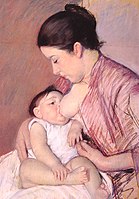
Maternité (1890), pastel
-

Nurse Reading to a Little Girl (1895), pastel
-
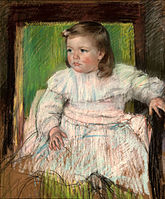
The Pinkish Sash (1898), pastel
-

Jules Beingness Dried by His Female parent (1900)
-

Young Woman in Light-green, Outdoors in the Sun (1914)
-
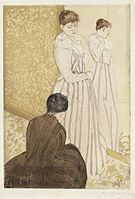
The Fitting (c. 1890), drypoint and aquatint, Brooklyn Museum
-
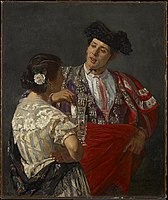
Offering the Panal to the Bullfighter (1873), oil on canvas, Clark Art Found
Notes [edit]
- ^ The cards are probably cartes de visite, used by artists and dealers at the fourth dimension to document their piece of work. Stephanie Strasnick suggests that Degas used them as a device to represent Cassatt as a peer and an artist in her own correct, although Cassatt later took an disfavor to the portrait and had it sold.[58]
- ^ Pro-Dreyfus included Camille Pissarro, Claude Monet, Paul Signac and Mary Cassatt. Anti-Dreyfus included Edgar Degas, Paul Cézanne, Auguste Rodin and Pierre-Auguste Renoir.[61]
References [edit]
- ^ "Mary Cassatt Self-Portrait". National Portrait Gallery. Smithsonian Establishment. Retrieved June 12, 2018.
- ^ Geffroy, Gustave (1894), "Histoire de 50'Impressionnisme", La Vie Artistique: 268 .
- ^ Moffett, Charles S. (1986). The New Painting: IMpressionism 1874–1886. San Francisco: The Fine Arts Museums of San Francisco. pp. 276. ISBN0-88401-047-3.
- ^ a b Roberts, Norma J. (1988). The American Collections. Columbus: Columbus Museum of Art. p. 36. ISBN978-0-918881-20-5.
- ^ Pollock 1998, p. 280.
- ^ Mathews 1998, p. 3.
- ^ a b c Rubinstein, Charlotte Streifer (1982). American women artists: from early Indian times to the present . Boston, Mass.: Hall. ISBN978-0816185351.
- ^ Pollock 1998, pp. 281–82.
- ^ Havemeyer, Louisine (1961). Sixteen to Sixty: Memoirs of a Collector. New York: Priv. Print. for the family of Mrs. H.O. Havemeyer and the Metropolitan Museum of Art. p. 272.
- ^ Perlman, Bennard B. (1991). Robert Henri: His Life and Art . New York: Dover Publications. p. one. ISBN978-0-486-26722-7.
- ^ a b c d "Mary Cassatt - The Consummate Works - Biography - marycassatt.org". www.marycassatt.org . Retrieved Nov 19, 2019.
- ^ Mathews 1998, p. 11.
- ^ McKown 1972, pp. ten–12.
- ^ Mathews 1998, p. 15.
- ^ a b c Dictionary of women artists. Gaze, Delia. London: Fitzroy Dearborn Publishers. 1997. ISBN978-1884964213. OCLC 37693713.
{{cite book}}: CS1 maint: others (link) - ^ Mathews 1994, p. 18.
- ^ McKown 1972, p. 16.
- ^ Mathews 1994, p. 29.
- ^ a b Mathews 1994, p. 31.
- ^ a b Mathews 1994, p. 32.
- ^ Mathews 1994, p. 54.
- ^ Mathews 1998, p. 47.
- ^ Mathews 1998, p. 54.
- ^ Mathews 1998, p. 75.
- ^ Mathews 1994, p. 74.
- ^ McKown 1972, p. 36.
- ^ MacPherson, Karen (June 20, 1999). "Lasting impressions: National Gallery exhibition displays unlike hues of Mary Cassatt". Postal service-gazette.com. Retrieved June 23, 2020.
- ^ Mathews 1994, p. 76.
- ^ Mathews 1994, p. 79.
- ^ Mathews 1994, p. 87.
- ^ Mathews 1998, pp. 104–105.
- ^ Mathews 1994, p. 96.
- ^ Mathews 1998, p. 100.
- ^ Mathews 1994, p. 107.
- ^ Mathews 1998, p. 114.
- ^ Mathews 1994, p. 118.
- ^ a b Mathews 1994, p. 125.
- ^ Zerbe, Kathryn J. "Essential Others and Spontaneous Recovery in the Life and Work of Emily Carr: Implications for Understanding Remission of Affliction and Resilience." International Journal of Psychoanalytic Cocky Psychology 11.1 (2016): 28–49. PMC. Web. October 26, 2016.
- ^ Mathews 1998, p. 163.
- ^ Jones, Kimberly A. (2014). Degas Cassatt. National Gallery of Art, Washington. p. 122.
- ^ Georgopulos, Nicole 1000. (December 2019). "Rethinking Mary Cassatt'due south 'Reflection' as a Cocky-Portrait". Print Quarterly. xxxvi (4): 425–38.
- ^ Mathews 1994, pp. 146–fifty.
- ^ Mathews 1994, pp. 128–31, 147.
- ^ McKown 1972, p. 73.
- ^ McKown 1972, pp. 72–73.
- ^ Mathews 1994, p. 167.
- ^ Holly Pyne Connor; Newark Museum; Frick Fine art & Historical Eye. Off the Pedestal: New Women in the Art of Homer, Chase, and Sargent. Rutgers University Press; 2006. ISBN 978-0-8135-3697-two. p. 25.
- ^ New Perspectives on Analogy: Gibson and Cassatt: Depicting the New Woman by Seo Kim. Norman Rockwell Museum. Retrieved March xviii, 2014.
- ^ Quinn, Bridget (August 17, 2020). "Mary Cassatt's Contained, Feminist Spirit". Hyperalergic. Retrieved August 30, 2020.
- ^ Mathews 1994, pp. 306–x.
- ^ Mary Cassatt: A Life, p. 306, at Google Books
- ^ Barter, pp. 354–355 "Mary Cassatt'due south Paris" (map). sfn error: no target: CITEREFBarter (assistance)
- ^ "To Theo van Gogh. Arles, Friday, iv May 1888". Vincent van Gogh: The Letters. Van Gogh Museum.
- ^ Bullard, p. xiv.
- ^ Duranty 1876.
- ^ MoMA Highlights: 350 Works from The Museum of Modern Fine art, New York, p. 31, at Google Books
- ^ "The Portraits | National Portrait Gallery".
- ^ Strasnick, Stephanie (March 27, 2014). "Degas and Cassatt: The Untold Story of Their Creative Friendship". ARTnews. Archived from the original on March 27, 2014.
- ^ Pollock 1998, p. 118.
- ^ a b Mathews 1994, p. 149.
- ^ Meiseler, Stanley (July 9, 2006). "History'due south new verdict on the Dreyfus case". Los Angeles Times. Archived from the original on January 9, 2014.
- ^ Mathews 1994, p. 275.
- ^ a b Shackelford, p. 137.
- ^ Mathews 1994, pp. 303, 308.
- ^ Mathews 1994, pp. 189–ninety.
- ^ Mathews 1994, pp. 312–13.
- ^ "The Child'south Bath" Archived May sixteen, 2012, at the Wayback Machine. The Art Establish of Chicago. Retrieved Apr 9, 2012.
- ^ Mathews 1998, p. 182 and annotation on p. 346.
- ^ Kloss 1985, p. 106.
- ^ "Women Impressionists: Berthe Morisot, Mary Cassatt, Eva Gonzalès, Marie Bracquemond". FAMSF. October 10, 2009. Retrieved October 7, 2021.
- ^ McKown 1972, p. 155.
- ^ McKown 1972, pp. 124–126.
- ^ "Woman Bathing (La Toilette)". world wide web.metmuseum.org . Retrieved January 25, 2020.
- ^ Lunardini, Christine A. (1997). What every American Should Know Nigh Women's History. Holbrook, Mass.: Adams Media Corporation. p. 129. ISBN978-1-55850-687-9.
- ^ Mary Cassatt's Lost Mural and Other Exhibits at the 1893 Exposition Archived September 28, 2009, at the Wayback Machine by K. L. Nichols
- ^ McKown 1972, p. 182.
- ^ Mathews 1998, p. 281.
- ^ Mathews 1998, p. 284.
- ^ "1913 Armory Prove List by Gallery". New York Historical Society. Retrieved February 1, 2014.
- ^ Mathews 1998, p. 291.
- ^ "Liberty Ships". Shipbuilding History. April 8, 2008. Retrieved May 20, 2018.
- ^ Berman, Greta. "A Blockbuster Duet at the Met". Juilliard School. Archived from the original on May 31, 2010. Retrieved May 20, 2018.
- ^ Welcher: String Quartets Nos. ane–3 Mary Cassatt at AllMusic
- ^ "The Canoeing Party, Mary Cassatt". US Postage stamp Gallery . Retrieved May xx, 2018.
- ^ National Women's Hall of Fame, Mary Cassatt
- ^ Carr, Rchard. "'American Treasures' Serial Honors Cassatt". tribunedigital-sunsentinel. Archived from the original on May 20, 2018. Retrieved May xx, 2018.
- ^ "Mary Cassatt's Altogether". Google. Retrieved April 9, 2012.
- ^ "Sale 8408 | Lot lxx". Christie'southward. May 23, 1996. Archived from the original on February 2, 2014.
- ^ "Jardin Mary-Cassatt – Equipements – Paris.fr". www.paris.fr . Retrieved January 31, 2019.
Bibliography [edit]
- Castling, Judith A. (October xv, 1998). Mary Cassatt, modern adult female (1st ed.). Fine art Institute of Chicago in association with H.Northward. Abrams. ISBN978-0810940895.
- Bullard, John E. (1972). Mary Cassatt: Oils and Pastels. Watson-Guptill Publications. ISBN0-8230-0569-0. LCCN 70-190524.
- Duranty, Louis Edmund (1990) [1876]. La Nouvelle peinture : À propos du groupe d'artistes qui expose dans les galeries Durand-Ruel, 1876 (in French). Paris: Echoppe. ISBN978-2905657374. LCCN 21010788.
- Mathews, Nancy Mowll (1994). Mary Cassatt: A Life. New York: Villard Books. ISBN978-0-394-58497-3.
- Mathews, Nancy Mowll (1998). Mary Cassatt: A Life. New Oasis: Yale University Press. ISBN978-0-585-36794-1.
- McKown, Robin (1972). The World of Mary Cassatt. New York: Thomas Y. Crowell Co. ISBN978-0-690-90274-7.
- Kloss, William (1985). Treasures from the National Museum of American Art. Washington: National Museum of American Art. ISBN978-0-87474-594-8.
- Pollock, Griselda; Florence, Penny (2001). Looking back to the Hereafter . Amsterdam: G+B Arts International. ISBN978-90-5701-122-1.
- Pollock, Griselda (1998). "Mary Cassatt: Painter of Women and Children". In Milroy, Elizabeth; Doezema, Marianne (eds.). Reading American Fine art. New Haven. ISBN978-0-300-07348-five.
- Shackelford, George T.M. (1998). "Pas de Deux: Mary Cassatt and Edgar Degas". In Barter, Judith A.. (ed.). Mary Cassatt, modern woman / with contributions past Erica E. Hirshler ... [et al.] New York: Harry N. Abrams, Inc. pp. 109–43. ISBN978-0810940895. LCCN 98007306.
- White, John H. Jr. (Leap 1986). "America's Almost Noteworthy Railroaders". Railroad History. 154: 9–15. ISSN 0090-7847. JSTOR 43523785. OCLC 1785797. (mentions family relationship to Alexander Cassatt)
Further reading [edit]
- Adelson, Warren; Bertalan, Sarah; Mathews, Nancy Mowll; Pinsky, Susan; Rosen, Marc (2008). Mary Cassatt: Prints and Drawings from the Drove of Ambroise Vollard. New York: Adelson Galleries. ISBN 0-9815801-0-half-dozen.
- Barter, Judith A., et al. Mary Cassatt: Modern Woman. Exhibition catalogue. New York: Art Institute of Chicago in clan with Harry Due north. Abrams, Inc., 1998.
- Breeskin, Adelyn D. Mary Cassatt: A Catalogue Raisonné of the Oils, Pastels, Watercolors, and Drawings. Washington, DC: Smithsonian Establishment Press, 1970.
- Conrads, Margaret C. American Paintings and Sculpture at the Sterling and Francine Clark Art Institute. New York: Hudson Hills Press, 1990.
- Pinsky, Susan; Rosen, Marc; Adelson, Warren; Cantor, Jay E.; Shapiro, Barbara Stern (2000). Mary Cassatt: Prints and Drawings from the Artist'due south Studio. Princeton, NJ: Princeton University Printing. ISBN 0-691-08887-X.
- Pollock, Griselda. Mary Cassatt: Painter of Modern Women. Globe of Art. London: Thames and Hudson, 1998.
- Stratton, Suzanne L. Kingdom of spain, Espagne, Spanien: Foreign Artists Observe Kingdom of spain 1800–1900. Exhibition catalogue. New York: The Spanish Constitute in association with the Equitable Gallery, 1993.
- Weinberg, H Barbara (2009). American impressionism and realism . New York: The Metropolitan Museum of Art. ISBN 0300085699 (see index)
External links [edit]
| External video | |
|---|---|
 Cassatt's The Child's Bathroom | |
| Cassatt's In the Loge | |
| Cassatt's Woman with a Pearl Necklace in a Loge | |
| Cassatt's The Loge All from Smarthistory |
- Jennifer A. Thompson, "On the Balustrade past Mary Stevenson Cassatt (W1906-1-seven)" [ permanent dead link ] in The John G. Johnson Collection: A History and Selected Works [ permanent expressionless link ] , a Philadelphia Museum of Art free digital publication.
- Mary Cassatt's True cat Paintings
- A finding assist to the Mary Cassatt letters, 1882–1926 at the Archives of Art, Smithsonian Establishment
- Mary Cassatt at the National Gallery of Art
- Mary Cassatt Gallery at MuseumSyndicate.com Archived May 27, 2009, at the Wayback Car
- Mary Cassatt at the WebMuseum.
- Mary Cassatt at Hill-Stead Museum, Farmington, Connecticut at the Wayback Motorcar (archived January 19, 2012)
- Mary Cassatt prints at the National Fine art History Institut (INHA) in Paris (in French)
- The Havemeyer Family unit Papers relating to Art Collecting Mary Cassatt was a shut personal friend of Louisine Havemeyer and acted as an art collecting counselor and buying agent for the Havemeyer family. This archival collection includes original letters from Mary Cassatt to Louisine and Henry Osborne Havemeyer.
- The foundation in French republic for the remembrance of Mary Cassatt, located in the village of Mesnil-Theribus, where Cassatt lived and is buried
- Bibliothèque numérique de l'INHA – Estampes de Mary Cassatt (in French)
Source: https://en.wikipedia.org/wiki/Mary_Cassatt
0 Response to "Art and Books Together Mary Cassatt Pictures of Herself"
Post a Comment