Freiends Went Vegan and Then Ate Meat Again
Some vegans believe meat causes cancer and destroys the planet. Simply meat-eaters often argue that giving up beast foods leads to nutritional deficiencies. Both sides say their approach is healthier. What does science say? And how can you best help clients, no thing their dietary preferences? Keep reading for the answers.
++++
Put a group of vegans and Paleo enthusiasts in the same social media thread, and one thing is near 99 per centum sure: They'll starting time arguing nigh food.
"Meat causes cancer!"
"Y'all need meat for B12!"
"But meat production leads to climate change!"
"Meat-free processed food is but equally bad!"
And on it will get.
Let's just say that, when it comes to the vegan vs. meat-eater fence, people have thoughts, and they experience strongly about them.
Who's right?
And which approach is right for you?
And what should you tell your clients?
As it turns out, the answers to those questions are nuanced.
In this article, you'll notice our take on the vegetarian vs. meat-eater debate, which you may find surprising—potentially fifty-fifty shocking—depending on your personal beliefs.
You'll larn:
- The real reasons establish-based diets may lower risk for affliction.
- Whether eating red and processed meat raises chance for certain diseases.
- How to eat for a better planet.
- Why some vegetarians feel better when they commencement eating meat—and, conversely, why some meat-eaters experience better when they go vegetarian.
- How to assist your clients (or yourself) weigh the true pros and cons of each eating approach.
(Desire more deep insights and helpful takeaways on the hottest health and nutrition topics? Sign up for our FREE weekly newsletter, The Smartest Coach in the Room.)
Vegan vs. vegetarian vs. found-based vs. omnivore: What does it all hateful?
Different people utilize plant-based, vegetarian, vegan, and other terms in unlike means. For the purposes of this article, here are the definitions we use at Precision Nutrition.
Found-based nutrition: Some ascertain this as "plants only." Simply our definition is broader. For us, plant-based diets consist generally of plants: vegetables, fruits, beans/legumes, whole grains, nuts, and seeds. In other words, if you consume mostly plants with some brute-based protein, Precision Nutrition would withal consider you a plant-based eater.
Whole-food plant-based diet: A type of plant-based diet that emphasizes whole, minimally processed foods.
Fully plant-based / plant-only diet: These eating patterns include only foods from the plant/fungi kingdom without any brute products. Fully establish-based eaters don't eat meat or meat products, dairy, or eggs. Some consume no brute byproducts at all—including honey.
Vegan diet: A blazon of strict, fully plant-based diet that tends to include broader lifestyle choices such equally not wearing fur or leather. Vegans often endeavor to avoid actions that bring harm or suffering to animals.
Vegetarian diet: "Vegetarian" is an umbrella term that includes plant-only diets (fully plant-based / plant-only / vegan) besides as several other plant-based eating patterns:
- Lacto-ovo vegetarians consume dairy and eggs.
- Pesco-pollo vegetarians eat fish, shellfish, and chicken.
- Pescatarians eat fish and shellfish.
- Flexitarians consume generally plant foods as well equally occasional, small servings of meat. A self-described flexitarian seeks to decrease meat consumption without eliminating it entirely.
Omnivore: Someone who consumes a mix of animals and plants.
Now that we know what the terms hateful, let'due south plow to the controversy at manus.
The Health Benefits of Vegetarian vs. Omnivore Diets
Many people assume that i of the big benefits of plant-only diets is this: They reduce adventure for disease.
And a number of studies support this.
For instance, when researchers in Belgium asked almost 1500 vegans, vegetarians, semi-vegetarians, pescatarians, and omnivores about their food intake, they plant that fully plant-based eaters scored highest on the Healthy Eating Alphabetize, which is a measure of dietary quality.
Omnivores (people who eat at least some meat) scored lowest on the Healthy Eating Index and the other groups scored somewhere in between. Meat eaters were also more than likely than other groups to be overweight or obese.i
Other research has as well linked vegetarian diets with meliorate health indicators, ranging from blood pressure level to waist circumference.2
So, is the instance closed? Should we all stop eating steaks, drinking lattes, and making omelets?
Not necessarily.
That'due south because your overall dietary design matters a lot more than than any i nutrient does.
Eat a diet rich in the following foods and food groups and it likely doesn't thing all that much whether you include or exclude animal products:
- minimally-candy whole foods
- fruits and vegetables
- protein-rich foods (from plants or animals)
- whole grains, beans and legumes, and/or starchy tubers (for people who swallow starchy carbs)
- nuts, seeds, avocados, extra virgin olive oil, and other healthy fats (for people who swallow added fats)
Of the foods we merely mentioned, most people—and we're talking more than ninety percent—practice not consume enough of one category in particular: fruits and vegetables. Fewer than 10 pct of people, according to the Centers for Disease Control, eat one.5 to two cups of fruit and 2 to iii cups of vegetables a day.3
In addition, other research has found that ultra-processed foods (think fries, ice cream, soda pop, etc.) at present make up nearly 60% of all calories consumed in the The states.4
Fully found-based eaters score higher on the Good for you Eating Index not because they forgo meat, just rather considering they consume more minimally-processed whole found foods such as vegetables, fruits, beans, basics, and seeds.
Since it takes work—label reading, food prep, card scrutiny—to follow this eating style, they may also exist more than witting of their food intake, which leads to healthier choices. (Plant-based eaters also tend to sleep more and watch less Idiot box, which can likewise boost health.)
And meat-eaters score lower non because they eat meat, only because of a depression intake of whole foods such as fish and seafood, fruit, beans, nuts, and seeds. They also have a higher intake of refined grains and sodium—2 words that normally depict highly-processed foods.
Meat-eaters, other inquiry shows, as well tend to beverage and fume more than institute-based eaters.v
In other words, meat may not be the trouble. A diet loaded with highly-processed "foods" and virtually devoid of whole, found foods, on the other hand, is a problem, regardless of whether the person following that diet eats no meat, a little meat, or a lot of meat.6
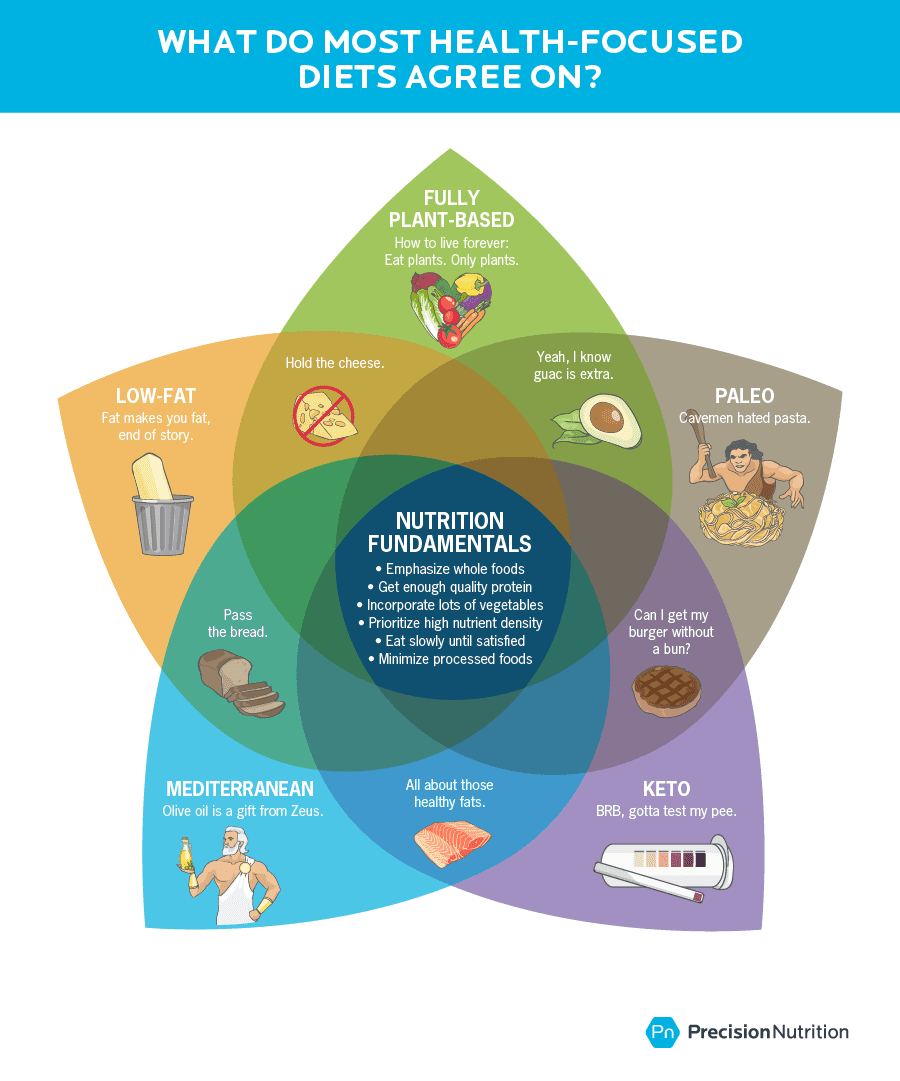
Now check out the middle of the Venn diagram below. It highlights the foundational elements of a healthful nutrition that virtually anybody agrees on, no thing what their preferred eating style.
These are the nutritional choices that have the greatest positive impact on your health.
Does meat cause cancer?
For years, we've heard that meat-eating raises risk for cancer, especially when information technology comes to cherry-red and processed meat.
And research suggests that ruby and processed meat tin can be problematic for some people.
Processed meat—lunch meat, canned meat, and jerky—equally well as heavily grilled, charred, or blackened reddish meat can introduce a host of potentially carcinogenic compounds to our bodies.vii,8 (This article offers a deeper dive into these compounds.)
Several years ago, after reviewing more than than 800 studies, the International Agency for Research on Cancer (IARC), a role of the Globe Health Organisation, determined that each daily 50-gram portion of processed meat—roughly the amount of 1 hotdog or half dozen slices of cooked bacon—increased adventure of colon cancer by 18 pct.
They listed carmine meat equally "probably carcinogenic" and processed red meat every bit "carcinogenic," putting it in the aforementioned category as smoking and alcohol. 9
And so no more salary, baloney, salami, or hotdogs, right?
Again, maybe not.
Beginning, we desire to exist clear: Nosotros don't consider candy meat a health food. In our Precision Nutrition nutrient spectrum, we put it in the "consume less" category.
Just "eat less" is not the same equally "eat never."
Why? Several reasons.
First, the research is a bit murky.
Several months ago, the Nutritional Recommendations international consortium, fabricated up of xiv researchers in vii countries, published five research reviews based on 61 population studies of more than than 4 meg participants, along with several randomized trials, to discern the link between carmine meat consumption and affliction.
Cutting dorsum on red meat offered a slim benefit, constitute the researchers, resulting in vii fewer deaths per 1000 people for crimson meat and eight fewer deaths per 1000 people for processed meat.10
(The report's main writer, though, has been heavily criticized for having ties to the meat industry. Some people have likewise questioned his methods. This article provides an in-depth assay.)
Overall, the panel suggested that adults go on their current ruby-red meat intake (both processed and unprocessed), since they considered the evidence against both types of meat to exist weak, with a low level of certainty.
In their view, for the majority of individuals, the potential health benefits of cut dorsum on meat probably do not outweigh the tradeoffs, such every bit:
- bear upon on quality of life
- the burden of modifying cultural and personal repast grooming and eating habits
- challenging personal values and preferences
Second, the IARC does list processed meat in the same category as cigarettes—because both do comprise known carcinogens—merely the caste that they increment risk isn't even close.
To fully explain this indicate, we want to offer a quick refresher on two statistical terms—"relative take a chance" and "absolute risk"—that many people tend to confuse.
Relative risk vs. absolute risk: What'south the departure?
In the media, you oftentimes hear that eating Ten or doing Y increases your gamble for cancer by 20, 30, even 50 pct or more. Which sounds terrifying, of form.
Simply the truth? It depends on what kind of risk they're talking about: relative run a risk or accented run a risk. (Hint: Information technology's commonly relative risk.)
Allow'southward expect at what each term means and how they relate to each other.
Relative risk: The likelihood something (such every bit cancer) will happen when a new variable (such every bit reddish meat) is added to a group, compared to a grouping of people who don't add that variable.
As noted earlier, on average, studies accept found that every l grams of processed red meat eaten daily raises relative run a risk for colon cancer by about eighteen per centum.11
Like we said, that certainly sounds scary.
Merely proceed reading because it's not equally dire as it seems.
Absolute chance: The amount that something (such every bit red meat) will raise your total risk of developing a problem (such every bit cancer) over time.
Your absolute hazard for developing colon cancer is well-nigh 5 pct over your lifetime. If you consume 50 grams of candy red meat daily, your absolute adventure goes up to six percent. This is a i percent ascent in absolute risk. (Going from 5 percent to half-dozen percent is, you lot guessed information technology, an xviii percent relative increase.)
So, back to smoking. Smoking doubles your risk of dying in the next x years. Smoking, by the way, also accounts for 30 percent of all cancer deaths, killing more than Americans than booze, car accidents, suicide, AIDS, homicide, and illegal drugs combined.
That'southward a lot more farthermost than the 1 percent increase in lifetime gamble you'd have by eating a daily hot canis familiaris.
Finally, how much red and processed meat raises your risk for affliction depends on other lifestyle habits—such as practice, sleep, and stress—too as other foods you consume.
Getting plenty of sleep, exercising regularly, not smoking, and eating a diet rich in vegetables, fruits and other whole foods can mitigate your take chances.
Is candy meat the best option around? No.
Must yous completely part ways with bacon, ham, and franks? No.
If you take no ethical bug with eating animals, there's no need to ban scarlet and processed meat from your dinner plate. Just avert displacing other good for you foods with meat. And keep intake moderate.
Think of information technology as a continuum.
Rather than eating less meat, you might start past eating more than fruits and vegetables.
You might become on to swap in whole, minimally-processed foods for ultra-processed ones.
Then y'all might change the way you melt meat, peculiarly the way you grill.
And and so, if yous desire to keep going, you might expect at reducing your intake of candy and red meat.
Okay, but at to the lowest degree plants are better for the planet. Right?
The answer, yet again, is pretty nuanced.
Generally speaking, consuming poly peptide from animals is less efficient than getting information technology direct from plants. On average, just most ten per centum of what farm animals swallow comes dorsum in the class of meat, milk, or eggs.
Unlike plants, animals also produce waste and methane gasses that contribute to climate change. "Raising animals for slaughter requires a lot of resources and creates a lot of waste product," explains Ryan Andrews, MS, MA, RD, CSCS, author of A Guide to Institute-Based Eating and adjunct professor at SUNY Buy.
For those reasons, a gram of poly peptide from beef produces roughly vii.5 times more carbon than does a gram of poly peptide from plants. Cattle contribute to about 70 per centum of all agronomical greenhouse gas emissions, while all plants combined contribute to just 4 per centum.12
Only that doesn't necessarily mean you lot must completely give up meat in order to save the planet. (Unless, of grade, y'all want to.)
For a 2019 report in the journal Global Ecology Modify, researchers from Johns Hopkins and several other universities looked at the ecology impact of nine eating patterns ranging from fully found-based to omnivore.13
Notably, they found:
- Reducing meat intake to just i meal a day cuts your environmental affect more does a lacto-ovo vegetarian diet.
- An eating pattern that includes small, low on the food chain creatures—think fish, mollusks, insects, and worms—poses a similar environmental impact as does a 100 pct plant-only diet.
In other words, if reducing your environmental impact is important to you, you don't necessarily need to go fully plant-based to exercise it. Y'all could instead endeavor whatsoever of the strategies beneath.
(And if you're not interested in taking environmental actions correct now, that's totally okay, too. Ultimately, that's a personal choice.)
5 means to reduce the environmental impact of your nutrition
1. Limit your meat intake.
Consider capping your consumption at 1 to 3 ounces of meat or poultry a day and your consumption of all animal products to no more than ten percentage of total calories, suggests Andrews.
For most people, this one strategy will reduce meat intake by more than than half. Replacing meat with legumes, tubers (such equally potatoes), roots, whole grains, mushrooms, bivalves (such every bit oysters), and seeds offers the most ecology do good for your cadet.
two. Choose sustainably raised meat, if possible.
Feedlot animals are often fed corn and soy, which are generally grown as heavily-fertilized monocrops. (Monocropping uses the same ingather on the same soil, year after year).
These sorts of heavily fertilized crops lead to nitrous oxide emissions, a greenhouse gas, simply crop rotation (irresolute the crops that are planted from flavor to season) can reduce these greenhouse gasses past 32 to 315 pct.fourteen
Cattle allowed to graze on grasses (which requires a considerable amount of land), on the other hand, offer a more sustainable pick, peculiarly if you lot can purchase the meat locally.
3. Eat more meals at home.
Homemade meals require less packaging than commercially-prepared ones, and they besides tend to upshot in less food waste material.
iv. Purchase locally-grown foods.
In addition to reducing transportation miles, local crops tend to besides exist smaller and more diversified. Veggies grown in soil also produce fewer emissions than veggies grown in greenhouses that use artificial lights and heating sources.
5. Slash your food waste.
Every bit food rots in landfills, it emits greenhouse gasses. "Wasted food is a double environmental whammy," explains Andrews. "When we waste nutrient, nosotros waste all of the resources that went into producing the nutrient. When we send food to the landfill, information technology generates a lot of greenhouse gases."
The Impossible Burger? Or the Imposter Burger?
Fabricated from found proteins (unremarkably wheat, pea, lentils, or soy) and heme (the iron-containing compound that makes meat red), several meat-like foods take popped up recently, including the Impossible Burger and the Beyond Meat Burger.
So should you requite up beef burgers and opt to eat only Impossible Burgers (or some other institute-based brand) instead?
The answer depends on how much yous like beef burgers.
That's considering the Impossible Burger is not healthier than a beefiness burger. It'due south but some other option.
It contains roughly the aforementioned number of calories and saturated fat as a beef burger. Information technology likewise has more than sodium and less poly peptide.
And, much similar breakfast cereal, it'southward fortified with some vitamins, minerals, and cobweb.
Rather than a health food, recall of the Incommunicable Burger as a meat substitute that doesn't come from a farm dependent on rubber antibiotics, which can lead to antibiotic resistance . If y'all want to get out and become a burger with friends, this is 1 way to exercise it.
But meat-similar burgers are non equal to kale, sweetness potatoes, quinoa, and other whole foods.
The same is true of pastas, breads, and baked goods that are fortified with pea, lentil, and other plant poly peptide sources.
These options are great for people who lead busy, circuitous lives—and especially helpful when used as a substitute for less salubrious, more highly-refined options. Just they're not a substitute for real, whole foods similar broccoli.
Whether the Impossible Burger is correct for your clients depends a lot on their values and where they are in their nutritional journey.
If clients want to surrender meat for spiritual reasons (for instance, they can't stand the thought of killing an animal), but aren't ready to encompass a diet rich in tofu, beans, lentils, and greens, poly peptide-enriched meat-gratis substitutes may be a adept style to help them align their eating choices with their values.
Isn't meat the best source of atomic number 26—not to mention a lot of other nutrients?
Meat eaters sometimes argue that one of the cons of a vegetarian nutrition is this: Without meat, information technology's harder to eat enough protein and sure minerals.
And there may be some truth to it.
Meat, poultry, and fish come up packed with several nutrients we all need for optimal health and well-being, including poly peptide, B vitamins, iron, zinc, and several other minerals.
When compared to meat, plants often contain much lower amounts of those of import nutrients. And in the case of minerals like iron and zinc, animal sources are more than readily absorbed than plant sources.
Retrieve that study out of Belgium that establish vegans had a healthier overall dietary pattern than meat-eaters? The same study establish that many fully plant-based eaters were deficient in calcium.1
Compared to other groups, fully plant-based eaters also took in the lowest amounts of poly peptide.
Plus, they ran a college risk of other food deficiencies, such equally vitamin B12, vitamin D, iodine, iron, zinc, and omega-3 fats (specifically EPA and DHA).
Is this proof that everyone should consume at least some meat?
Not actually. It just means that fully establish-based eaters must work harder to include those nutrients in their diets (or accept a supplement in the case of B12).
This is true for whatever diet of exclusion, past the manner. The more than foods someone excludes, the harder they take to piece of work to include all of the nutrients they need for adept health.
The Pros and Cons of Vegetarian Diets
Vegetarian diets brand information technology easier to reduce disease run a risk as well as carbon emissions, but harder to consume plenty protein, along with a host of other nutrients. This is especially true if someone is fully found-based or vegan. If your client is fully constitute-based, work with them to make sure they're getting these nutrients.
Protein: Seitan, tempeh, tofu, edamame, lentils, and beans. You might also consider adding a found-based poly peptide powder
Calcium: Dark leafy greens, beans, nuts, seeds, calcium-set up tofu, fortified plant milks
Vitamin B12: A B12 supplement
Omega-3 fats: Flax seeds, chia seeds, hemp seeds, walnuts, dark leafy greens, cruciferous vegetables, and/or algae supplements
Iodine: Kelp, sea vegetables, asparagus, dark leafy greens, and/or iodized salt
Iron: Beans, lentils, nighttime leafy greens, seeds, nuts and fortified foods
Vitamin D: Mushrooms exposed to ultraviolet light, fortified plant milks, and sun exposure
Zinc: Tofu, tempeh, beans, lentils, whole grains, nuts, and seeds
To help y'all consume enough of these nutrients each day, as part of your overall intake, aim for at least:
- three palm-sized portions of protein-rich institute foods
- one fist-sized portion of nighttime leafy greens
- 1-two cupped handfuls of beans*
- 1-two thumb-sized portions of nuts and/or seeds
* Merely need 1 portion equally a carb source if too using beans as a daily protein source.
But this found-based influencer started eating meat—and she says she feels great. Doesn't that prove something?
Maybe y'all've read about Alyce Parker, a formerly fully plant-based video blogger, who tried the carnivore nutrition (which includes only meat, dairy, fish, and eggs) for one calendar month. She says she ended the calendar month leaner, stronger, and more mentally focused.
Here's the thing. You don't have to search the Internet besides long to find a story in the contrary.
A while back, for example, John Berardi, PhD, the co-founder of PN, tried a near vegan diet for a month to run into how information technology affected his power to proceeds musculus.
During his veggie claiming, he gained nearly 5 pounds of lean body mass.
So what's going on? How could one person reach their goals by switching to a meat-heavy diet and another exercise so by giving up meat?
One or more of the following may be going on:
Dietary challenges tend to make people more enlightened of their behavior.
And awareness provides fertile ground for healthy habits.
New eating patterns require shopping for, preparing, and consuming new foods and recipes. This calls for free energy and focus, and so people invariably pay more attention to what and how much they consume.
An interesting study bears this out. Researchers asked habitual breakfast skippers to eat three meals a twenty-four hour period and habitual breakfast eaters to skip breakfast and eat only ii.
Other groups continued breakfast as usual—either skipping it (if they didn't eat it to begin with) or eating information technology (if they were already breakfast enthusiasts).
Subsequently 12 weeks, the study participants who changed their breakfast habits—going from eating it to skipping information technology or skipping it to eating it—lost 2 to six more pounds than people who didn't change their morn habits.
Whether or not people ate breakfast mattered less than whether they'd recently changed their behavior and become more aware of their intake.fifteen
Dietary changes may fix mild deficiencies.
People who follow restrictive eating patterns, whether they're fully plant-based or carnivore, run the risk of nutritional deficiencies.
By switching to a different, just as restrictive eating pattern, people may fix one deficiency—but somewhen cause some other.
Dietary changes may solve subtle intolerances.
Fully institute-based eaters, for instance, who accept trouble digesting lectins (a type of institute protein that resists digestion) volition probably experience better on a meat-only nutrition.
But they could also potentially solve the problem without any meat—simply by soaking and rinsing beans (which helps to remove lectins). Or by eating some meat and fewer lectin-rich foods.
Finally, the placebo result is powerful.
When nosotros believe in a handling, our brains tin can trigger healing—fifty-fifty if the treatment is fake or a sham (such as a saccharide pill). For this reason, every bit long as someone believes in a dietary change, that modify has the potential to assist them feel more than energized and focused.
Bottom line: Any eating pattern can be healthy or unhealthy.
Someone can technically follow a fully-constitute based nutrition without eating any actual whole plants.
For case, all of the following highly refined foods are meat-complimentary: snack fries, fries, sweets, sugary breakfast cereals, toaster pastries, soft drinks, and so on. And meat-eaters might also include like foods.
Vegetarian and carnivore diets merely bespeak what people eliminate—and not what people include.
Whether someone is on the carnivore diet, the keto nutrition, the Mediterranean diet, or a fully plant-based nutrition, the pillars of good health remain the same.
If you have potent feelings most certain eating patterns (for instance, maybe you're an evangelical vegetarian or Paleo follower), try to put those feelings aside so you can cipher in on your client's values and needs—rather than an eating pattern they think they "should" follow.
What you might find is that most clients truly don't intendance about extreme eating measures similar giving up meat or giving upwards carbs. They just want to get healthier, leaner, and fitter—and they don't care what eating pattern gets them in that location.
How do we know this?
Data.
Each month, roughly lxx,000 people use our free nutrition reckoner. They tell us what kind of an eating blueprint they want to follow, and our reckoner and then provides them with an eating programme—with hand portions and macros—that matches their preferred eating way. We give options for just nigh everything, including plant-based eating and keto.
What eating pattern do most people pick?
The "eat anything" pattern. In fact, a full two-thirds of users cull this selection, with the remaining third spread across the other five options.
In other words, they don't particularly intendance what they eat as long as it helps them reach their goals. Interestingly, of the many options we list, people cull fully plant-based and keto diets the least.
And then rather than fixating on a "all-time" diet, help clients align their eating choices with their goals and values.
Ask questions like: What are your goals? What is your life like right at present? What skills do you already take (can yous soak beans and swallow hummus and veggie wraps)? What are the foods you like to swallow that make you lot feel skilful?
Encourage clients to supervene upon what they remove.
The more foods on someone's "don't eat" list, the harder they must work to supercede what they're non eating.
For fully institute-based eaters, that ways replacing creature protein with plant proteins found in seitan, tofu, tempeh, beans, and pulses.
For Paleo, that ways replacing grains and dairy with vegetables, fruits, and sweetness potatoes.
For keto eaters, that means replacing all carbs with vegetables and healthy fats similar extra virgin olive oil, nuts and avocado.
Don't just offering advice on what to eat. Spend time on how.
At Precision Nutrition, we encourage people to enjoy meals, eat slowly, and pay attention to internal feelings of hunger and fullness. Nosotros've establish that these cadre practices alone can drive major transformation—and may be even more of import than the nutrient people put on their plates.
(Learn more virtually the benefits of eating slowly.)
Aid them focus on being better, not perfect.
Think of nutrition as a spectrum that ranges from nada nutrition (fries, sweets, and highly refined foods) to stellar nutrition (all whole foods).
Near of usa fall somewhere between those ii extremes—and that's okay, even preferred. Later on all, nosotros encounter huge gains in health when we go from zero nutrition to average or in a higher place average.
Simply eventually, we experience diminishing returns.
The difference between a mostly whole foods diet and a 100 percent whole foods diet? Marginal.
So rather than aiming for perfect, it's more than realistic to try to consume a little better than you are now.
For good health, a niggling better for most people involves eating more minimally-processed whole foods, especially more vegetables and more poly peptide (whether from animal or plant foods).
If your clients swallow carbs, they'll want to shift toward college-quality options similar:
- fruit
- whole grains
- beans
- legumes
- starchy tubers (such every bit yams and potatoes)
If they eat added fats, they can challenge themselves to showcase healthier choices such as:
- avocados
- nuts
- seeds
- olives and olive oil
Depending on the person, that might involve calculation spinach to a morning omelet, adding grilled chicken to their usual dejeuner salad, snacking on fruit, or ordering a sandwich with guac instead of mayo.
These might sound like small actions—and that's precisely the bespeak. Unlike huge dietary overhauls, it'due south these minor, accessible, and sustainable deportment that truly lead to lasting change.
More 100,000 clients take taught us:
Consistent pocket-size actions, repeated over time, add upwardly to big results.
And here'southward the beautiful part: When you aught in on these smaller, more than accessible practices, you'll terminate locking horns with clients whose beliefs autumn on the contrary side of the meat vs. meat-free debate every bit your own.
Instead, yous tin can piece of work together to build universal skills and actions that everyone needs—more sleep, eating slowly, more than veggies—whether they eat meat or not.
References
Click here to view the information sources referenced in this commodity.
- Clarys P, Deliens T, Huybrechts I, Deriemaeker P, Vanaelst B, De Keyzer W, et al. Comparison of nutritional quality of the vegan, vegetarian, semi-vegetarian, pesco-vegetarian and omnivorous diet. Nutrients. 2014 Mar 24;6(three):1318–32.
- Rizzo NS, Sabaté J, Jaceldo-Siegl K, Fraser GE. Vegetarian dietary patterns are associated with a lower risk of metabolic syndrome: the adventist health report 2. Diabetes Care. 2011 May;34(v):1225–seven.
- Lee-Kwan SH, Moore LV, Blanck HM, Harris DM, Galuska D. Disparities in State-Specific Adult Fruit and Vegetable Consumption – United States, 2015. MMWR Morb Mortal Wkly Rep. 2017 November 17;66(45):1241–7.
- Martínez Steele E, Baraldi LG, Louzada ML da C, Moubarac J-C, Mozaffarian D, Monteiro CA. Ultra-processed foods and added sugars in the US diet: evidence from a nationally representative cross-sectional written report. BMJ Open up. 2016 Mar 9;6(3):e009892.
- Bradbury KE, Spud N, Fundamental TJ. Nutrition and colorectal cancer in U.k. Biobank: a prospective study. Int J Epidemiol [Internet]. 2019 Apr 17; Available from: http://dx.doi.org/ten.1093/ije/dyz064
- Murray CJL, Atkinson C, Bhalla G, Birbeck K, Burstein R, Chou D, et al. The state of U.s. health, 1990-2010: burden of diseases, injuries, and risk factors . JAMA. 2013 Aug 14;310(6):591–608.
- Jägerstad G, Skog K. Genotoxicity of estrus-processed foods. Mutat Res. 2005 Jul 1;574(one-two):156–72.
- Cross AJ, Sinha R. Meat-related mutagens/carcinogens in the etiology of colorectal cancer . Environ Mol Mutagen. 2004;44(1):44–55.
- Bouvard V, Loomis D, Guyton KZ, Grosse Y, Ghissassi Iron, Benbrahim-Tallaa 50, et al. Carcinogenicity of consumption of cerise and candy meat. Lancet Oncol. 2015 Dec;16(16):1599–600.
- Han MA, Zeraatkar D, Guyatt GH, Vernooij RWM, El Dib R, Zhang Y, et al. Reduction of Red and Processed Meat Intake and Cancer Mortality and Incidence: A Systematic Review and Meta-analysis of Accomplice Studies. Ann Intern Med [Internet]. 2019 October i; Available from: http://dx.doi.org/x.7326/M19-0699
- Bradbury KE, Murphy N, Central TJ. Diet and colorectal cancer in UK Biobank: a prospective study. Int J Epidemiol [Cyberspace]. 2019 Apr 17; Available from: http://dx.doi.org/10.1093/ije/dyz064
- Gardner CD, Hartle JC, Garrett RD, Offringa LC, Wasserman As. Maximizing the intersection of human health and the health of the environment with regard to the amount and blazon of poly peptide produced and consumed in the United States. Nutr Rev. 2019 Apr i;77(4):197–215.
- Kim BF, Santo RE, Scatterday AP, Fry JP, Synk CM, Cebron SR, et al. Country-specific dietary shifts to mitigate climate and water crises. Glob Environ Change. 2019 Aug 7;101926.
- Liu C, Cutforth H, Chai Q, Gan Y. Farming tactics to reduce the carbon footprint of crop cultivation in semiarid areas. A review. Agron Sustain Dev. 2016 Nov xvi;36(4):69.
- Schlundt DG, Hill JO, Sbrocco T, Pope-Cordle J, Sharp T. The role of breakfast in the treatment of obesity: a randomized clinical trial. Am J Clin Nutr. 1992 Mar;55(iii):645–51.
If you're a charabanc, or you want to be…
You can help people build nutrition and lifestyle habits that improve their concrete and mental wellness, bolster their immunity, help them better manage stress, and get sustainable results. We'll testify you how.
If y'all'd like to acquire more, consider the PN Level 1 Nutrition Coaching Certification.
Source: https://www.precisionnutrition.com/vegan-vs-meat-eater
0 Response to "Freiends Went Vegan and Then Ate Meat Again"
Post a Comment